Sales · October 27, 2026
The Target You Beat Is the Target You Will Pay For
People respond to the system they work in, and the system teaches them that exceeding the plan has a price.
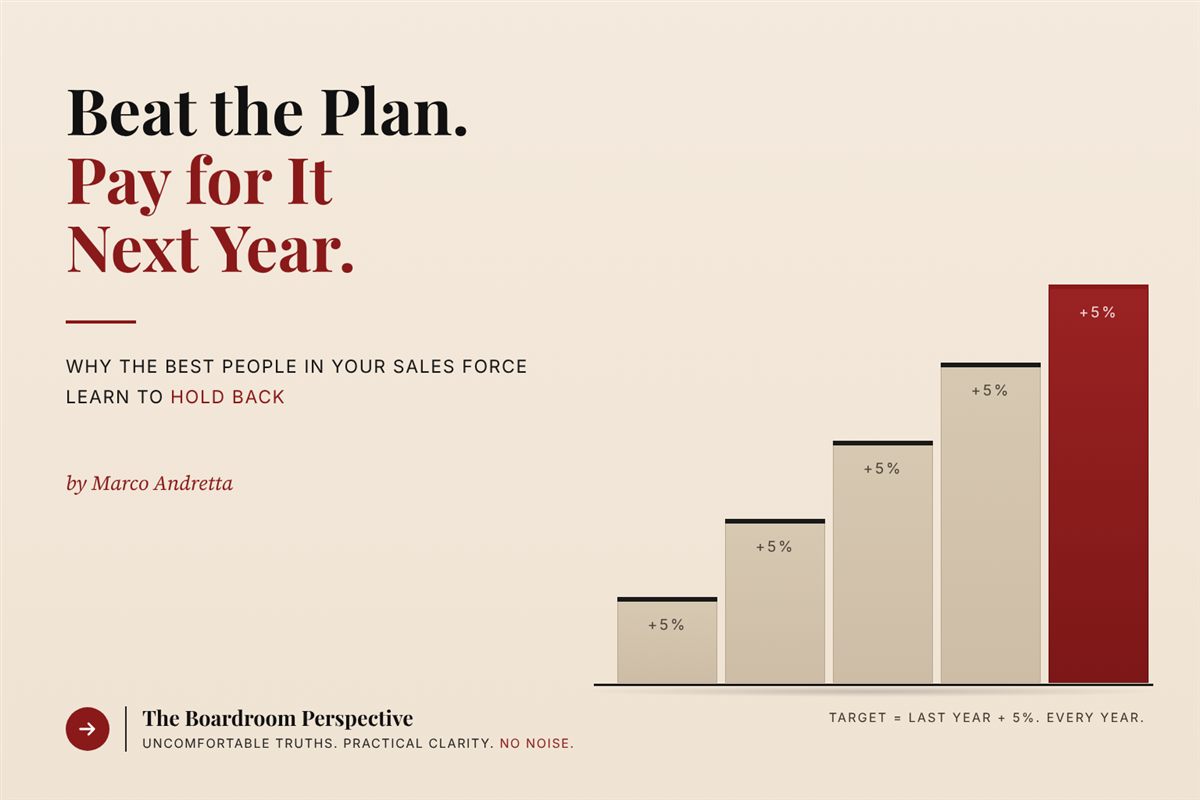
It is the last week of October. In most companies I know, the budget meeting is already in someone’s diary. Somebody will open a spreadsheet, take this year’s number, add a percentage, and call it next year’s target.
It looks sensible. It is also one of the oldest incentive problems in economics, and it has a name.
In 1980 Martin Weitzman described what he called the ratchet principle: when next period’s target depends partly on this period’s result, performing well today makes tomorrow harder. He was writing about planned economies, where factory targets were set from last year’s output. The logic travels. Anyone who has watched a good salesperson “manage” a strong quarter has seen it.
In 2018 Management Science published a study by F. Brahm and J. Poblete. The setting was a Chilean beverage company with a multiproduct sales force. They varied monthly goals for 53 salespeople in a way the salespeople could not predict, then watched what they did.
Where people did not expect their goals to rise with their results, they behaved as you would expect. They sold more of the product where effort paid better, and less where it paid worse. Where they did expect high ratcheting, the behavior reversed. They sold less in the category where the return had improved, and more in the one where it had fallen.
Average sales, in the end, did not move. The authors attribute this to people holding different expectations about the ratchet, which canceled out in the average, rather than to people ignoring the incentive.
That last point deserves a second reading. A flat average can hide a sales force that is busy responding to the wrong signal. Nothing in the P&L would tell you.
I should be careful here. This is one company, one country, 53 people, and a consumer product with short sales cycles. It is evidence that the mechanism exists. It is not evidence that your distributors behave the same way.
The paradox: fair on paper, punitive in practice
Conventional thinking says that a target based on history is objective. Nobody chose it. It simply came from the numbers.
But a salesperson is not a machine reading a target. She is reading the board. She knows that a very strong December becomes a very difficult January the following year. So the rational reply is to keep something back. Close the big order in the first week of next month. Do not bring in the account that would take you 40 percent over plan.
Nobody has to be dishonest for this to happen. This is the part I would underline for any board. People respond to the system they work in, and the system teaches them that exceeding the plan has a price.
Holmström and Milgrom’s work on multitask incentives (1991) adds a second layer. When people are paid on what is easy to measure, effort moves away from what is hard to measure. In a sales force, volume and margin are measured. Building a new architect relationship, or keeping a dealer healthy, is not. A ratcheting target sharpens that pull, because the measured number is now both the reward and the threat.
Why this matters more in a flat market
Take the interiors industry. According to Furnilytics, reported by InteriorDaily on 23 July 2026, European furniture production in real terms reached about EUR 98.6 billion in 2025, against a peak of EUR 111 billion in 2022. That is roughly 8 percent below pre-COVID levels. Sector turnover has grown in nominal terms, but the same analysis says that growth has come almost entirely from price rather than volume.
Treat that as one analytics firm’s estimate. It is useful as a direction, not as a number to quote to a bank.
If it is broadly right, consider what a “last year plus 5 percent” target means in such a market. The volume is not there. So the extra five points must come from somewhere: price increases the trade may resist, market share taken from a competitor, or a quiet shift of orders between months. The first is a decision. The second is a strategy. The third is what often happens, because it is the only one a sales manager controls by the end of the quarter.
This is interpretation, and I want to be clear about that. I have no data on how many firms do this. What I am describing is a mechanism that economic theory predicts and one experiment has observed, applied to a market where the pressure on the target is high.
Inside the boardroom
Look at who benefits from the ratchet. The CFO gets a forecast that reflects the latest data. The CEO gets a stretching plan to show the board. The board gets reassurance that nobody is being allowed to coast. Each of them is acting reasonably.
The cost lands elsewhere, in the part of the organization that has no seat at the table. The sales force quietly learns to sell to the target, not to the market. The best people, the ones who would clearly exceed plan, learn it fastest.
A fair counterargument is that the alternative is worse. If targets ignore results, they drift away from reality. History is the best information a board has about what people can achieve, and ignoring it has a cost too. The point is not that the ratchet should be abolished. It is that most boards have never decided how strong it should be.
The commercial consequences
When the pattern takes hold, three things tend to follow. Order timing becomes a negotiation. Customers notice, and some learn they can wait for a better price at the end of a period. The strongest performers have the most to protect, so they hold back the most.
Management loses the one thing the target was supposed to give it: an honest view of what the market will bear. A plan built on stretched, managed numbers is a plan nobody quite believes.
The long-term cost is harder to see.
“A sales organization that learns to avoid outperforming is training itself to stay average.”
The management test
- How much of last year’s overperformance is carried into this year’s target, and has anyone written the rule down?
- When did we last compare orders signed in the final two weeks of each period with the two weeks that followed? What does the pattern say?
- If our top five performers were asked, privately, whether they ever delay a deal for next year’s target, what would they answer and would we want to hear it?
A target is a message about what the company will do with success. If the message is “we will take it all back next year”, people will hide their success. The board that wants honest numbers has to start by deciding what it is willing to leave on the table.
© 2026 Marco Andretta. All rights reserved. The Boardroom Perspective is an independent newsletter. The views expressed are personal and do not refer to any specific company or individual.