Leadership · October 12, 2026
Get Out of the Way. Most Leaders Can’t.
Hunger for power and hunger to win look identical from the outside. They are not the same thing — and confusing them is the most expensive mistake in management.
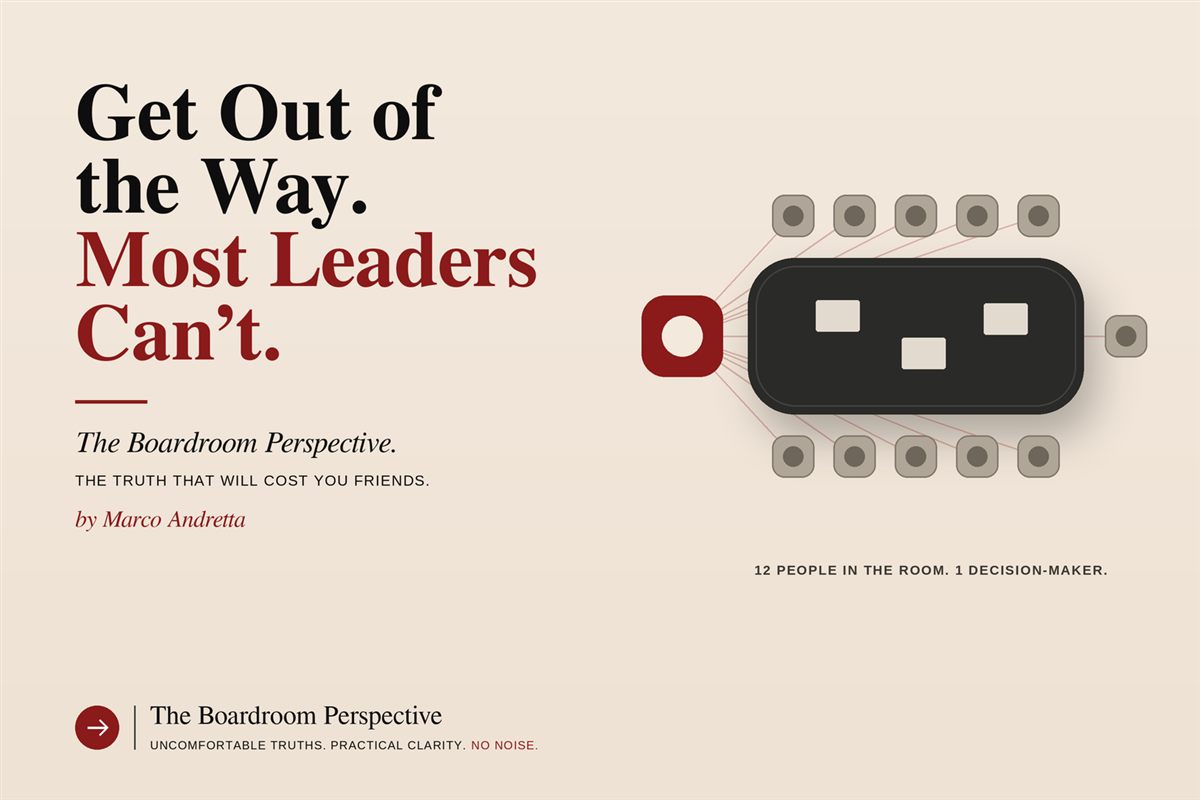
Last year I sat in a meeting that should have lasted twenty minutes. It lasted three hours. Twelve people were in the room. Eleven of them said almost nothing. The twelfth, the one with the biggest title, decided everything, corrected everything and, at the end, thanked the team for “a great discussion”.
Nobody had discussed anything.
I left with a simple thought. This company does not have a leadership problem because it lacks leaders. It has one because it has a leader who never leaves the room. Sergio Marchionne once said: “For me, the only thing a leader can do is point to a general direction, then get out of the way. Surround yourself with the best people you can find and let them work.” It sounds obvious. In 25 years of international business, I have met very few people who actually do it.
Two different hungers
Hunger for power and hunger to win look identical from the outside. Both work late. Both talk about ambition. Both say “results” in every sentence. They are not the same thing.
“The person who wants to win needs the team to be strong. The person who wants power needs the team to be dependent.”
One builds people. The other builds an audience.
I spend a median of 30 weeks a year travelling, visiting clients and teams in retail and in contract, in family businesses and in large groups. The pattern repeats everywhere. Only the paperwork changes. And the confusion between the two hungers is the most expensive mistake in management. Because from the outside, a power-hungry manager looks like a high performer for years. Sometimes for a whole career.
The family business version
In a family business, power comes with the surname. The founder built everything, so every decision still passes through the founder. Even the small ones. Especially the small ones. I have seen a founder approve the color of a brochure and ignore a collapsing distribution network in the same week. The best managers leave. The loyal ones stay and learn one skill: guessing what the boss wants. The company becomes slow, polite and fragile.
Then comes the next generation, and it often gets worse. The heir has to prove something. So they overrule. They confuse control with legitimacy. They fire the people who knew the founder, and then they hire people who will never contradict them. Family businesses often say, “We are a family.” Then they treat talent like staff and staff like suspects. The sad part is that many of these companies have real strengths. A strong brand. Patient capital. Deep craft. Loyal customers. All of it wasted because one person cannot stop needing to be the center.
The multinational version
In a multinational, power comes with the title. It is more refined, but it is the same disease. The manager climbing the ladder needs visibility. So they centralize decisions, multiply reports and schedule meetings where they can be seen deciding. They claim credit for wins. Failures are always local. Strategy is always “aligned”. They do not lead. They manage their own career with other people’s results.
I have watched country managers sit on information for months because sharing it would reduce their importance. I have watched regional directors refuse to promote their best person because that person was “too valuable where they are”. Different structure. Same hunger.
What Marchionne actually meant
Let me be careful here, because this quote is easy to misuse. Marchionne was famously demanding. Stepping back did not mean lowering the bar. It did not mean absence, delegation by disappearance, or leadership by newsletter. It meant three things.
- The leader owns the direction. Not every decision, only the direction. If the direction is unclear, the team cannot run, however talented it is.
- The leader chooses people. This is the most underrated decision in business. Choosing someone better than you in their field is not weakness. It is the whole job.
- The leader accepts discomfort. When you step back, you will see decisions you would have made differently. Some will be worse. Some will be better. You have to live with both.
Most managers fail at the third one. It is not a skill problem. It is an ego problem.
Data nobody frames
Gallup’s 2026 State of the Global Workplace report shows that only 20% of employees worldwide were engaged in 2025, the lowest level since 2020. Gallup also keeps finding that managers account for at least 70% of the variance in team engagement. Read these two numbers together. Four out of five people are not really in the game, and the person who decides that is mostly the manager. Secondary summaries of the report also say that only about one manager in five is engaged. Check the full report before you quote that one.
This is not a motivation problem. It is a leadership problem that we keep describing as an HR problem. We run surveys. We hire consultants. We launch “culture programs”. And we ignore the simplest explanation: the person who sits above the team is the main variable.
The anatomy of a destructive manager
They are rarely incompetent. That is what makes them dangerous. They are fast, sharp and visible. They know the numbers. They speak well in front of the board. And you can spot them:
- They answer every question themselves, even the ones nobody asked them.
- They hire people who are weaker than they are, then complain about the level of the team.
- They call dependency “alignment” and silence “buy-in”.
- They keep information close and release it in doses.
- They lose their best people and call it “a cultural reset”.
- When something works, it was their idea. When something fails, it was execution.
The scoreboard may look fine for a while. Then it doesn’t, and they are already in the next role, with a story ready. What remains is a team that has learned to wait. A team that no longer proposes, because proposals get rewritten. A team that no longer decides, because decisions get reversed. That is the real cost. Not the one on the P&L. The one in the heads of the people who stopped trying.
A simple test
- How many decisions did my team take last month without asking me?
- When did someone last tell me I was wrong in a meeting?
- Who on my team is better than me at something important?
- What happens to the business if I am unreachable for three weeks?
- Do I want to be right, or do I want us to win?
If the answers make you uncomfortable, good. That is the point.
The Provocation
A leader who cannot leave the room has not built a company. They have built a bottleneck with a salary. If your team cannot decide without you, the problem is not the team.
The hardest test of leadership is not what happens when you are in the meeting. It is what happens when you are not. The best leaders I know are the ones whose teams barely notice when they leave.
© 2026 Marco Andretta. All rights reserved. The Boardroom Perspective is an independent newsletter. The views expressed are personal and do not refer to any specific company or individual.